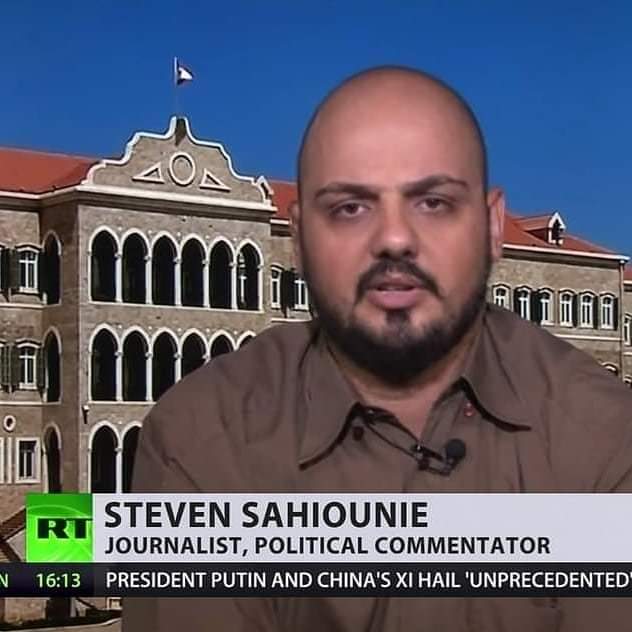


Steven Sahiounie, journalist and political commentator
U.S. special envoy Steve Witkoff met with Russian President Vladimir Putin on Wednesday. Trump has characterized the meeting as having achieved "great progress".
On Friday, Trump has threatened Putin with new sanctions for failure to make peace with Ukraine. Trump has pulled in India and China into the negotiations, by imposing 25% duties on India for buying Russian oil, and has threatened China with the same.
Trump is using his position as President of the world's superpower, to threaten other nations into compliance with the Oval Offices demands.
Steven Sahiounie of MidEastDiscourse interviewed Dragana Trifkovi, Director General of the Center for Geostrategic Studies in Belgrade. She is geopolitical analyst and was an advisor on security and international relations in the Serbian Parliament.
1. Steven Sahiounie (SS): Former Prime Minister of Russia, Dmitri Medvedev, has made a number of provocative statements directed at U.S. President Donald Trump. What do you make of the timing of his statements?
Dragana Trifkovi (DT): Dmitry Medvedev, Deputy Chairman of the Security Council of the Russian Federation, one of the key positions in Russia's security and defense structure, was actually responding to ultimatums issued by Donald Trump to Russia. Imposing deadlines for resolving the Ukrainian conflict is counterproductive. First and foremost, the positions of the key actors in the conflict remain completely divergent. Russia considers Zelensky an illegitimate negotiator because his presidential mandate has expired. Additionally, Russia wants to discuss the root causes of the war, which implies direct negotiations with the United States, whom it holds responsible for initiating the conflict. Ukraine has maximalist demands, seeking Russia's withdrawal and war reparations, which are completely unrealistic. The U.S. wants a swift end to the conflict but without a clear plan or participation in negotiations. The West wants to freeze the conflict in Ukraine as soon as possible because Russia holds strategic initiative on the front. Furthermore, Trump has promised his voters that he will end the war in the shortest possible time. On the other hand, Russia finds acceptable only a strategic solution that includes aligning international security frameworks. All of this greatly complicates the situation, and with sharp rhetoric between Moscow and Washington which amounts to public provocation involving nuclear threats it represents one of the most dangerous diplomatic moments between the U.S. and Russia in recent times.
(Note: You can view every article as one long page if you sign up as an Advocate Member, or higher).