




Party-first progressive opposition to corporate Party leadership protects the enemies of progressive policy. It's one reason Party support among voters has dwindled in noticeable, electoral ways.
"Open Rebellion," in contrast, threatens to force wider the split between the corporatists and progressives. It forces pro-corporate members of the Party to decide, in public and in plain view, between loyalty to their donor base and support for policies preferred by their voter base. If closed rebellion is what Go players would call a "weak move," open rebellion is a "strong move."
The entire Sanders candidacy was an act of open rebellion, and support for it was massive. By accepting a position within Senate Democratic leadership and continuing to advocate for his populist economic agenda, his open rebellion continues. He rarely criticizes other Democrats, but he never backs down from his original proposals, and he never fails to put other Democratic office holders on the spot as to their support for them. In my view, this is brilliant strategy, brilliant leveraging of his position as the most popular politician in America.
Your first takeaway -- Sanders' Medicare-for-All bill is another act of open rebellion; it puts Democrats on the spot. You can read more about this bill and its reception in these pages. It's enough to say for now that mainstream Senators in the caucus (as opposed to actual or known progressives) are divided in their support for his bill based on whether they're flirting with a presidential run in 2020, or prefer to be bound instead by ties of loyalty and money to Democratic leaders, their power, and their leadership PACs' deep pockets.
Industry Money and Democratic Support
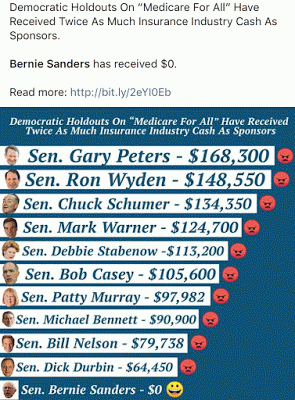
The second point to consider when looking at Democratic office holders' opposition to (or silence about) Medicare-for-All, is where their campaign financing comes from. There's a good discussion of that here. This graphic contains the primary message:
Note the names of such "progressives" as Ron Wyden, Debbie Stabenow, Patty Murray and Dick Durbin, all silent or opposed to Medicare-for-All.
Note also pieces like this, from David Sirota:
"As Sanders Prepared Medicare Bill, Health Care Lobbyists Bankrolled Senate Democrats
"As Bernie Sanders worked to finalize his Medicare-for-All Act of 2017, corporate lobbyists representing the traditional opponents of single-payer health care -- including the nation's major private insurers and drug companies -- poured hundreds of thousands of dollars into Senate Democrats' fundraising accounts. Now, many of those lawmakers have refused to sign on to the Medicare bill.
"Sanders has faced questions about whether or not the bill would garner solid support among Senate Democrats. So far, 16 Senate Democrats have said they will sponsor the legislation -- which the insurance industry slammed after he announced it. A new study from campaign finance watchdog group MapLight found that since 2010, Democratic senators who have refused to sponsor the bill have, during their careers, raised twice as much insurance industry cash as those who support the legislation."
As Sanders continues to press for public support among Democratic office holders and leaders, not only will pressure from public opposition to them grow, but the number of revelations like the above will increase.
Ignoring the Savings
The third point to notice is the most important and the hardest to find. Not only are the highest cost estimates being taken as the "headline number" for coverage in the mainstream (i.e., corporate) press -- as well as those left-leaning sites that support neoliberal and Clintonist policies -- but the obvious savings to consumers, which offset all costs, are ignored.
To take a made-up example, if the cost to a family of four in extra taxes is, say, $100 per month, but the savings in insurance premiums that no longer have to be paid is $150 per month, the net effect is a savings -- $50 per month, or $600 per year -- plus a much better health care system with its much-improved health outcomes.
(Note: You can view every article as one long page if you sign up as an Advocate Member, or higher).
 1
1