
This piece was reprinted by OpEd News with permission or license. It may not be reproduced in any form without permission or license from the source.
As tensions with Russia heightened late last decade, Sen. Bradley added, "Right now we are confronted with something that could have easily been avoided."
Finally Saying Nyet
A week after Bradley's lament, Russian Foreign Minister Sergey Lavrov called in U.S. Ambassador William Burns to read him the riot act. The subject line of Burns's CONFIDENTIAL cable #182 of Feb. 1, 2008, in which he reported Lavrov's remarks to Washington shows that Burns played it straight, choosing not to mince his own or Lavrov's words: "Nyet means nyet: Russia's NATO enlargement redlines."
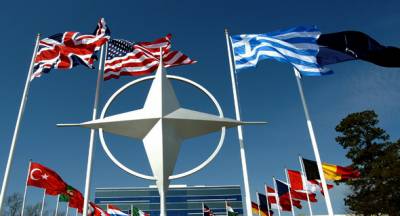
NATO headquarters in Brussels, Belgium.
Here what Ambassador Burns wrote in his summary, which the public knows because the cable was among the thousands leaked to WikiLeaks by Pvt. Bradley (now Chelsea) Manning, for which she was imprisoned for seven years and only recently released (yet the cable has been essentially ignored by the corporate U.S. news media):
"Following a muted first reaction to Ukraine's intent to seek a NATO Membership Action Plan at the Bucharest summit, Foreign Minister Lavrov and other senior officials have reiterated strong opposition, stressing that Russia would view further eastward expansion as a potential military threat. NATO enlargement, particularly to Ukraine, remains an emotional and neuralgic issue for Russia, but strategic policy considerations also underlie strong opposition to NATO membership for Ukraine and Georgia.
"In Ukraine, these include fears that the issue could potentially split the country in two, leading to violence or even, some claim, civil war, which would force Russia to decide whether to intervene. Additionally, the government of Russia and experts continue to claim that Ukrainian NATO membership would have a major impact on Russia's defense industry, Russian-Ukrainian family connections, and bilateral relations generally."
So, it is not as though then-Secretary of State Condoleezza Rice and other U.S. policymakers were not warned, in very specific terms, of Russia's redline on Ukrainian membership in NATO. Nevertheless, on April 3, 2008, the final declaration from at a NATO summit in Bucharest asserted: "NATO welcomes Ukraine's and Georgia's Euro-Atlantic aspirations for membership in NATO. We agreed today that these countries will become members of NATO."
The Ukraine Coup
Six years later, on Feb. 22, 2014, the U.S.-pushed putsch in Ukraine, which George Friedman, then President of the think-tank STRATFOR, labeled "the most blatant coup in history," put in power a fiercely anti-Russian regime eager to join the Western alliance.
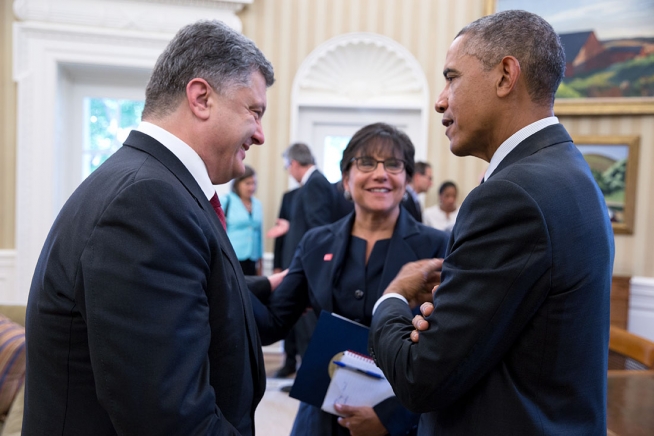
President Barack Obama talks with President Petro Poroshenko of Ukraine and Commerce Secretary Penny Pritzker following a bilateral meeting in the Oval Office, Sept. 18, 2014. (Official White House Photo by Pete Souza)
Russia's reaction was predictable -- actually, pretty much predicted by the Russians themselves. But for Western media and "statesmen," the Ukrainian story begins on Feb. 23, 2014, when Putin and his advisers decided to move quickly to thwart NATO's designs on Ukraine and take back Crimea where Russia's only warm-water naval base has been located since the days of Catherine the Great.
U.S. officials (and The New York Times) have made it a practice to white-out the coup d'etat in Kiev and to begin recent European history with Russia's immediate reaction, thus the relentless presentation of these events as simply "Russian aggression," as if Russia instigated the crisis, not the U.S.
A particularly blatant example of this came on June 30, 2016, when then U.S. Ambassador to NATO Douglas Lute spoke at a press briefing before the NATO summit in Warsaw:
(Note: You can view every article as one long page if you sign up as an Advocate Member, or higher).
 6
6
 3
3
 2
2