But wait, it gets worse. The point of a BMD is to print a ballot from a disabled-accessible voting device. Yet it failed to perform its primary function, and Sequoia knew it didn't work, as did the SBOE.
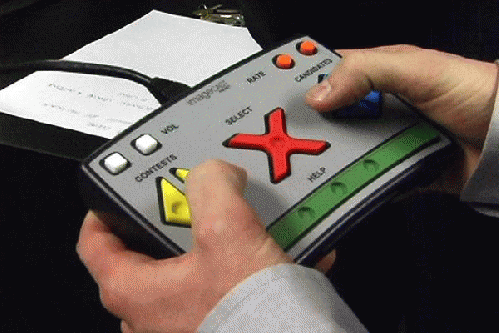
Barrett continues:
"In addition, the SBOE failed to respond to correspondence from the Nassau County Board of Elections dated April 10, 2008, apprising them of problems with the BMDs and failed to inform Nassau that Sequoia discovered a 'systematic problem' involving its printers that cause paper jams."
Think about this a moment: an $11,500 ballot printing device (plus $250 for shipping, plus local testing costs, etc.) failed to print the ballots, which Sequoia understood to be a systemic problem, and which warning the SBOE failed to send to counties.
Counties are justifiably anxious and angry about the new systems, with their exorbitant price tag, their failure to perform, their fragility, and the additional pollworker training required. All of these factors hamper the ability of election administrators to run sound elections. No wonder NY's election officials have hung on to their levers for six years, while the rest of the nation was hoodwinked into buying "crap."
State and federal money covered 95% of Dutchess County's $1.8 million for 155 Sequoia BMDs, leaving Dutchess with a $95,000 BMD bill, plus another $56,000 for transport, storage and overhead. Republican elections Commissioner, David Gamache, commented last Friday:
"That's why I'm saying: many more dollars, but a lot less sense. [Levers] have done a heck of a job for generations. They're very durable. They're mechanical. Basically, you can drop them down a flight of stairs and they'd still work."
Software Cannot Be Reliably Certified
As the SBOE certifies nonfunctional equipment, it learns to its dismay that software cannot be certified. Avi Rubin explained this pretty well last year:
"The current certification process may have been appropriate when a 900 lb lever voting machine was deployed. The machine could be tested every which way, and if it met the criteria, it could be certified because it was not likely to change. But software is different. The software lifecycle is dynamic...[Y]ou cannot certify an electronic voting machine the way you certify a lever machine.... [W]e absolutely expect that vulnerabilities will be discovered all the time....
"Software is designed to be upgraded, and patch management systems are the norm. A certification system that requires freezing a version in stone is doomed to failure because of the inherent nature of software."
The History of Levers
Historical experience favors nuts-and-bolts technology over fragile paper that can easily be lost, destroyed or altered. Anyone who has researched the history of US election fraud is well aware how easy it is to defraud a paper ballot voting system.
Professor Bryan Pfaffenberger of the University of Virginia Dept. of Science, Technology & Society was awarded a National Science Foundation grant to study the lever voting machine. In Machining the Vote, he defends levers, which were designed with an eye toward paper ballot fraud, as superior to newer systems:
"In my analysis, the lever machine deserves recognition as one of the most astonishing achievements of American technological genius, a fact that is reflected in their continued competitiveness against recent voting technologies in every accepted performance measure." (emphasis added)
Next Page 1 | 2 | 3 | 4 | 5 | 6
(Note: You can view every article as one long page if you sign up as an Advocate Member, or higher).