





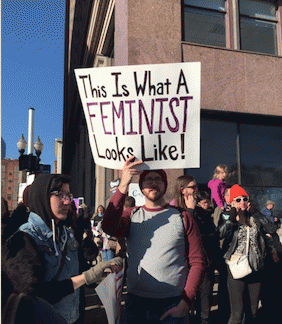
HW: In the course of my life I have been on quite a few big marches, and there are always two dimensions to them. The most obvious is what might be called the public dimension. A march seeks to change the trajectory of public events. This one certainly did that. January 21 offered tangible evidence--something that surveys could not do--that there is a huge army of people who feel very intensely about what Trump is trying to do to this country. This stiffens the spines of Democratic politicians, and unnerves quiescent Republicans. I believe that it has also affected the mass media coverage of Trump. We have a lively progressive news service in this country that is important, but it does not reach a mass audience. Mainstream media had never been sure about how to cover someone like Trump. Since the demonstrations however, there has been a marked change in the tenor of mass media coverage. It has been much more critical and now openly calls out at least some of Trump's more notorious lies. And the coverage of the Muslim ban, to cite but one example, has been much more critical. I'm not saying the marches were totally responsible for this change, but mainstream media--profit seeking institutions all--have to be mindful of the fact that there is a huge audience that wants more critical, which is to say more truthful, coverage of Trump.
The second dimension of the march's impact is private, or internal. A march like this does something to the souls of marchers. A huge number of people who marched on January 21, if one can believe anecdotal reports, had never done so before. They probably thought they were simply marching for a cause, and were taken by surprise at the joyfulness such acts of solidarity generate. Everyone I have talked with about the marches, in Chicago, in DC and elsewhere--that includes scores of people--wanted to talk about how personal this very public experience was for them. And this turns out to be a second impact: This is not going to be a "one and done" deal. One week after the marches, people flocked to U.S. airports in outrage over the Muslim ban. Congressmen report that their email and phone contacts with constituents has increased five fold, and that it is overwhelmingly anti-Trump. Local citizen action groups are springing to life all over the country.
Obviously there is much work to be done and much evil that the Trump regime will be able impose. But think about how people felt three weeks ago compared to how they feel now. I believe the marches are significantly responsible for this change.
JB: I have definitely noticed this empowering phenomenon as well. Speaking of the private, internal impact, how has this changed how you feel, how you act going forward?
HW: I have long been familiar with the old Chinese curse, "May you live in interesting times," but I never fully grasped its significance until now. This is not exactly what I had in mind in retirement! On the other hand anyone who has a family, or who has been fortunate enough to have had contact with young people in their jobs, has little choice. I will remain politically active. There is no way I'm checking out so long as Trump is president.
JB: Good to know. Thanks so much for giving us a glimpse into the making of the Women's March in Chicago, Harry. This was fun.
***
*Others in the "Signs of Sisterhood" series:
(Note: You can view every article as one long page if you sign up as an Advocate Member, or higher).
 1
1
 1
1