Still from "The Dark Knight Rises"
With the news media having already done their best to defeat the Occupy movement, the resonance some have noted between the uprising in The Dark Knight Rises and Occupy Wall Street is just the kind of simplistic, visceral demonization of a particular group that does brainwash people and lead to violence against that group -- whether in the form of hate crimes or just in acquiescence with the abusive practices of authorities or government policies. The way this works is illustrated, for example, in Vito Russo's groundbreaking book The Celluloid Closet (also a film), which shows how Hollywood has propagandized against LGBT characters, often having them either die tragically or become killers. (One notorious example was William Friedkin's Cruising, which gay-bashers referenced directly.) Jack Shaheen's encyclopedic tome Reel Bad Arabs (now a doc as well) exposes Hollywood's shabby, stereotyped, and hostile treatment of Arabs and Muslims on-screen. (Another Friedkin film, Rules of Engagement, vilifies the people of one such country and was probably very helpful in inculcating support for U.S. bombing in that part of the world.) The Dark Knight Rises, even if it was never deliberately meant to invoke Occupy Wall Street, adds another powerful element to an already dangerous technological, political, and cultural mix in our society that breeds hatred and violence. This must be very pleasurable for Frank Miller, the graphic novelist who created the ultra-violent Sin City, the racist and war-mongering 300, and the Batman comic book series which had the most influence on Nolan's film trilogy. He made headlines with a hysterical screed against Occupy on his site last November.
Nolan, meanwhile, has tried to stress to interviewers that A
Tale of Two Cities was the conscious
inspiration for The Dark Knight Rises , not Occupy. Indeed, Commissioner Gordon (Gary Oldman) reads aloud
from the novel in the film, equating Batman with the self-sacrificing Sydney
Carton hero. But in A Tale of Two Cities Charles Dickens wasn't just critiquing the Red Terror, he was issuing a
warning, essentially the same as JFK issued: "those who make peaceful
revolution impossible, make violent revolution inevitable." Dickens doesn't get
to the carnival of death of the French Revolution until after he has poignantly
described the gross injustices suffered by the French masses under their
oppressors -- so we can see how the violence perpetrated by the aristocracy came
back to literally bite their heads off.
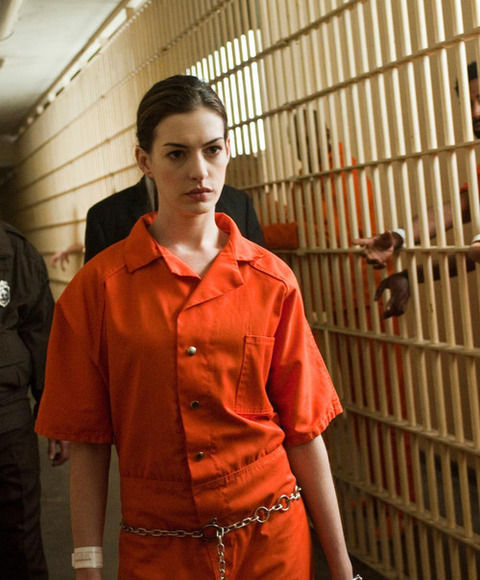
Catwoman in orange in a still from "The Dark Knight Rises"
By contrast, all The Dark Knight Rises has to represent the plight of the downtrodden is the Catwoman-origin-story of scrappy,
slinky Selina Kyle (Anne Hathaway), who makes class-conscious jibes at our
billionaire hero. Kyle resents the wealth of Batman's alter-ego Bruce Wayne,
makes statements about inequity, and has to cat-burgle to pay her rent. This
sure doesn't justify a revolution the way Dickens did, with a nobleman
callously running over a pauper's child, and aristocratic brothers hiding their
rapes and murders by incarcerating an innocent physician, in solitary, forever.
Still, as in Dickens' classic, prisons are a prominent motif
in Nolan's third Batman film. An aggressive new city ordinance has swelled the
prison ranks of Gotham -- and when the doors open, those thugs hurry to exact
revenge. Like many comic book superheroes and archvillains, The Dark Knight
Rises is a model of Freudian theory: Batman
certainly experienced an original trauma, and there's an excruciating origin
story on the villain side as well, revealed in the climax. It revolves around
an exotic, primitive prison where the inmates are dropped down to the bottom of
a deep pit they can never escape, taunted only by a small circle of burning
sunlight high above. This experience destroys the psyche, as indefinite
detention did to the gentle doctor in A Tale of Two Cities.
However, it should be noted that the neglected prisoners in The
Dark Knight Rises wear desert-climate robes
and face-concealing head scarves, they live in a barren vaguely Eastern land, and oh yes, they claw and tear at each other, because the assumption is
that's a region where there's always civil unrest, I guess. Perhaps that is why
Batman cares only about Gotham, and doesn't try to get the prisoners out of
their hell-hole; perhaps their lives are naturally barbaric, and they have none
of the First World's right to a decent life.
A rope-and-pulley system to help them escape would be
nothing to this billionaire with an engineering firm. Bruce Wayne uses, as his
butler Alfred (Michael Caine) puts it, "air superiority" to defeat evil. (This
joke is delivered in the middle of a taut action sequence; it's amusing unless,
of course, "air superiority" makes you think of U.S. war crimes.) But if The
Dark Knight Rises is going to lay messiah
vibes on Batman -- he's got a little resurrection thing going on, and Les
Miserables of the Asian prison feel it and chant for him worshipfully
-- then it's unlikely the movie really sees him and them as fellow humans.
Rising Up from the Hell-Hole
A survivor of the terror attack on Colorado's midnight screening, but the friend of one of the twelve who were murdered, is suing Warner Bros., among other defendants, on the grounds that the 2008 Dark Knight film incited James Holmes to commit his heinous imitation of the Joker.
While lawsuits like this are understandable as a way to vent
the rage and grief such a senseless loss engenders, what could the legal
grounds be? And who would be more legally liable, filmmakers who create wooden
characters and one-dimensional plots, or those who craft convincing films?
(Note: You can view every article as one long page if you sign up as an Advocate Member, or higher).
 2
2
 1
1
 1
1