




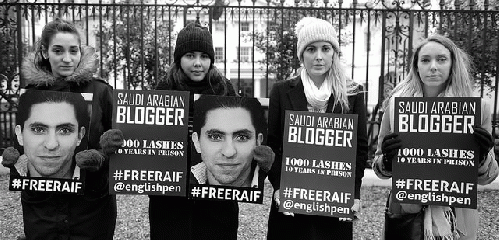
London protest against Saudi Arabia's detention of prisoner of conscience Raif Badawi.
(Image by Alisdare Hickson) Details DMCA
That Badawi's conviction was in violation of Saudi domestic law (the court that convicted him lacked jurisdiction, relied on inadmissible evidence and denied him his right to counsel) or an affront to Saudi Arabia's obligations under international law is of no concern to the Crown Prince.
London protest against Saudi Arabia's detention of prisoner of conscience Raif Badawi.
(Image by Alisdare Hickson) Details DMCA
Badawi has become one of the world's most celebrated prisoners of conscience and has been honored with the Sakharov Prize of the European Parliament, the PEN Pinter Prize and the Reporters Without Borders Press Freedom Prize and the Courage Award from a coalition of 20 human rights groups from around the world at the Geneva Summit for Human Rights and Democracy.
As the Crown Prince basks in the favorable press surrounding lifting the driving and cinema bans, do not forget that
- earlier this month Badawi marked his 6th year in prison;
- 17 women's rights activists were arrested weeks before the driving ban was lifted including prominent women's rights activist Eman al-Nafjan who was arrested for driving in Riyadh in 2011; and
- the guardianship system remains largely in place.
Quite simply, Saudi Arabia has one of the worst human rights records of any country on this planet and the Crown Prince is doing little to change that. Ben Emmerson, United Nation's Special Rapporteur, conclude d that "[r]eports that Saudi Arabia is liberalizing are completely wide of the mark."
Under Crown Prince Mohammed bin Salman, Saudi Arabia is undergoing the most ruthless crackdown on political dissent that the country has experienced in decades . . Those who peacefully exercise their right to freedom of expression are systematically persecuted in Saudi Arabia. A culture of impunity prevails for public officials who are guilty of acts of torture and other ill-treatment. Peaceful avenues for redress of grievances are foreclosed by the use of repressive measures to silence civil society.
The Black Panther headlines may have masked the fact that there has been a 70-percent increase in beheadings during the first quarter of 2018 (half of them for non-violent offenses).
The Saudi regime has continued to engage in war crimes in Yemen through air strikes that target hospitals, schools, mosques and even funeral gatherings. It also has intensified a blockade of Yemen that deprives large areas of food, fuel and medicine and is triggering a humanitarian crisis.
The Obama administration suspended certain arms transfers to the Saudi regime in protest, but they have resumed under President Trump and Congress blocked a resolution to end U.S. involvement in Yemen earlier this year. Saudi Arabia, after all, is the largest purchaser of U.S. weapons and our largest source of foreign oil outside of North America.
The Pearl family and the Los Angeles Press Club are to be commended for honoring Badawi's courage and calling for his release. The bigger question, however, for we as Americans is what has happened to our own courage and that of our government?