Most Popular Choices
Share on Facebook 99 Printer Friendly Page More Sharing Summarizing
OpEdNews Op Eds      

Forty Years Past Che

By       (Page 2 of 5 pages) Become a premium member to see this article and all articles as one long page.   3 comments

Kathlyn Stone
Follow Me on Twitter     Message Kathlyn Stone
Become a Fan
  (1 fan)

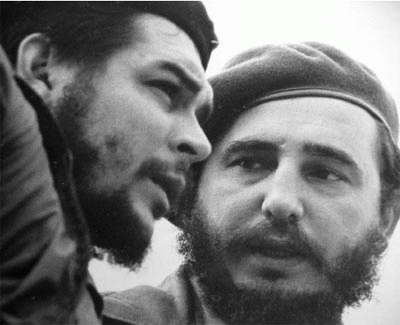
He returned to Argentina to complete his medical studies at Buenos Aries Medical School in 1953.   Che Guevara’s quest to bring freedom to the people of Cuba began in 1956. In November of that year he joined with Fidel Castro and 80 other revolutionaries and sailed from Mexico to Cuba.  A major battle took place against Batista’s forces in 1958 and in 1959, Che Guevara became part of the new Cuba governing regime.  Two Chinese journalist, Mai K’ung and An Ping, interviewed Che Guevara in 1959, shortly after the Cuban revolution took place. During the interview he described the difficulties the revolutionaries had experienced, such as being pursued by the Mexican  

(Image by Unknown Owner)   Details   DMCA

authorities, the disagreements that caused some members to leave the movement, and the difficulty of traveling over mountains. He also shared that he learned it was essential to have the working class join in the revolution and fight for it. He said that the only foreign enemies of the revolution were those that had economic interests and connections with the U.S. State Department.   

The U.S. government considered him a threat and the news media were fascinated by him. Both closely followed the activities of Che Guevara. Numerous articles about him were featured in Time magazine and other media. Time ran an illustration of Che Guevara on its cover in August 1960.

Che Guevara held several positions in the new Cuban government, including head of the national bank, and was considered Fidel Castro’s right hand.  However, he remained committed to overthrowing other oppressive regimes and in 1965 he left Cuba to lead revolutions in Latin America and Africa.  

In his farewell letter to Castro, written April 1, 1965, Che Guevara wrote: Other nations of the world summon my modest efforts of assistance. I can do that which is denied you due to your responsibility as the head of Cuba, and the time has come for us to part.  

You should know that I do so with a mixture of joy and sorrow. I leave here the purest of my hopes as a builder and the dearest of those I hold dear. And I leave a people who received me as a son. That wounds a part of my spirit. I carry to new battlefronts the faith that you taught me, the revolutionary spirit of my people, the feeling of fulfilling the most sacred of duties: to fight against imperialism wherever it may be. This is a source of strength, and more than heals the deepest of wounds.’


In 1967, while leading a small guerilla band of revolutionaries in Bolivia, he was captured and wounded by members of the Bolivian Army. He was executed a few days later on October 9, 1967. He was buried in the small village of Vallegrande, Bolivia.


Che Guevara’s revolutionary statements and activities had made government leaders throughout Latin America nervous. U.S. president Lyndon Johnson sent men to assist in finding and eventually killing Che Guevara in Bolivia. Declassified memos and telegrams sent to the president describe the U.S. military’s training of Bolivian troops to fight the guerillas, updates on Che Guevara’s whereabouts, and confirmation of his death.  

Next Page  1  |  2  |  3  |  4  |  5

(Note: You can view every article as one long page if you sign up as an Advocate Member, or higher).

Rate It | View Ratings

Kathlyn Stone Social Media Pages: Facebook page url on login Profile not filled in       Twitter page url on login Profile not filled in       Linkedin page url on login Profile not filled in       Instagram page url on login Profile not filled in

Kathlyn Stone is a Minnesota-based writer covering science and medicine, health care and related policies.ï ¿ ½She publishes www.fleshandstone.net, a health and science news site.
Go To Commenting
The views expressed herein are the sole responsibility of the author and do not necessarily reflect those of this website or its editors.
Follow Me on Twitter     Writers Guidelines

 
Contact AuthorContact Author Contact EditorContact Editor Author PageView Authors' Articles
Support OpEdNews

OpEdNews depends upon can't survive without your help.

If you value this article and the work of OpEdNews, please either Donate or Purchase a premium membership.

STAY IN THE KNOW
If you've enjoyed this, sign up for our daily or weekly newsletter to get lots of great progressive content.
Daily Weekly     OpEd News Newsletter

Name
Email
   (Opens new browser window)
 

Most Popular Articles by this Author:     (View All Most Popular Articles by this Author)

Vietnam Vets need to know: Agent Orange effects can come 30 years or more after exposure; benefits available

Forty Years Past Che

Black women and AIDS. Fix this!

Electron filmed for the first time

The oligarchs are coming! The oligarchs are coming!

World's largest super collider taken down for repairs

To View Comments or Join the Conversation:

Tell A Friend